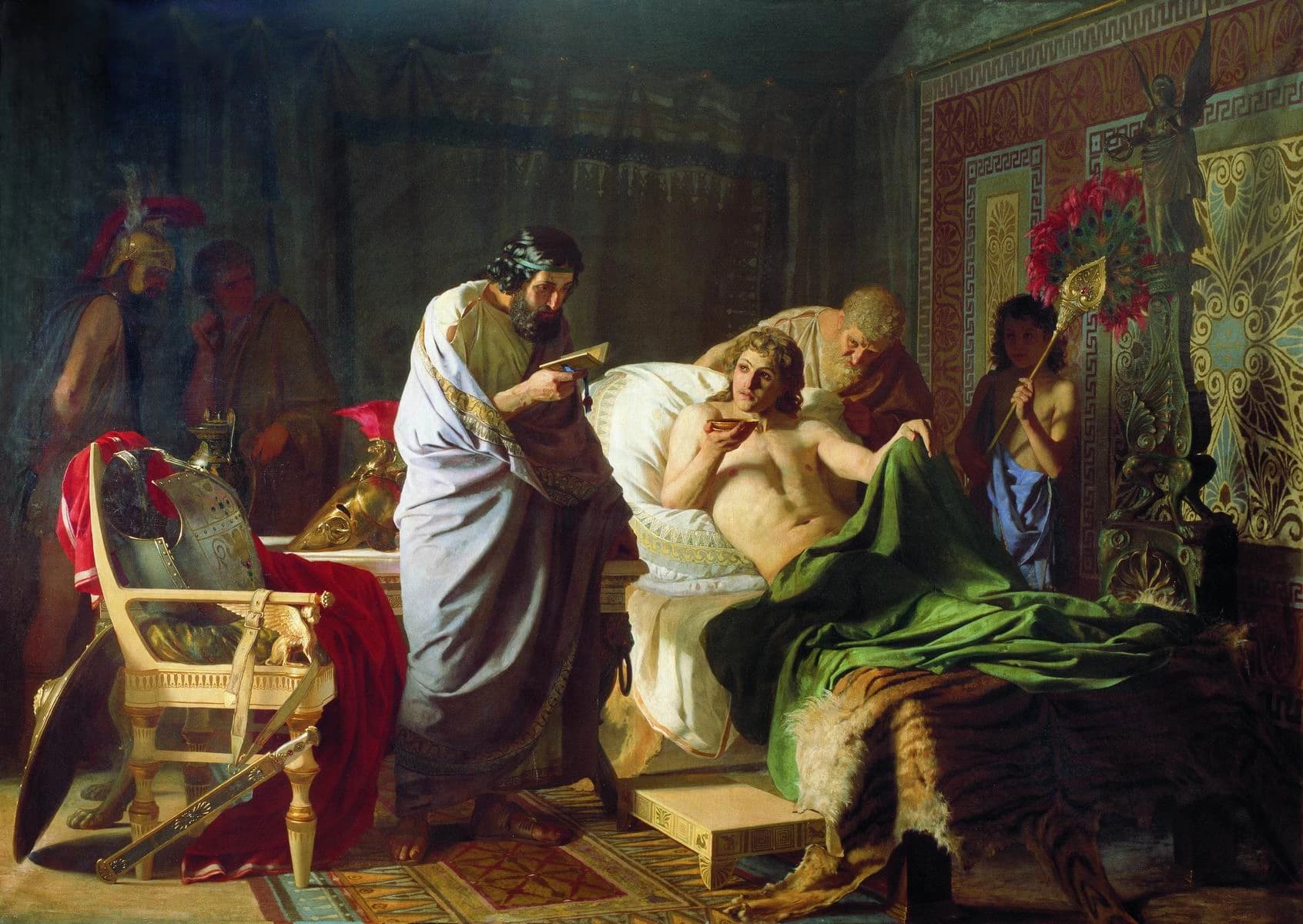
Artist
Henryk Siemiradzki
Timeline
Born in 1843 to a Polish noble family in present-day Ukraine. His father was a general in the Imperial Russian Army, but the family maintained strong Polish cultural ties and were close friends with Adam Mickiewicz's family.1
He studied natural sciences at Kharkiv University and earned a degree, but abandoned a scientific career for art. In 1864, he began formal painting studies at the Imperial Academy of Arts in Saint Petersburg.1
His first teacher was Dmytro Bezperchy, a student of Karl Briullov. He later studied under the master of historical painting Karl von Piloty in Munich, which laid the foundation for his monumental historical works.1

He moved to Rome in 1872 and established a studio on Via Gaeta. He spent most of his creative life in Italy, vividly depicting the ancient Greco-Roman world under the bright Mediterranean light.1
In 1873, he presented 'Christ and a Sinner,' inspired by Aleksey Tolstoy's poem, and was awarded the title of Academician. This marked the beginning of his international fame.1

He won a gold medal at the 1878 Paris World's Fair and was awarded the French Legion of Honour. His works were acquired by national galleries across Europe, establishing his international reputation.1
His masterpiece 'Nero's Torches' depicts the shocking persecution of early Christians. His donation of this work to the Polish National Museum in 1879 served as the catalyst for the museum's collection.1
He is also known for creating monumental theater curtains, such as those for the Juliusz Słowacki Theatre in Kraków and the Lviv Opera, which remain iconic symbols of these institutions today.1
After his death in 1902, his remains were moved to the national Pantheon on Skałka in Kraków. He continues to be deeply respected as one of Poland's greatest artists.1