Artist
Félix Resurrección Hidalgo
Timeline
Born in Manila in 1855, he initially studied law but turned to art, moving to Madrid in 1879 on a scholarship to study at the Real Academia de Bellas Artes de San Fernando.1
Winning the silver medal at the 1884 Madrid Exposition alongside Juan Luna's gold, he proved Filipino equality to Spaniards, inspiring reformists like José Rizal.1
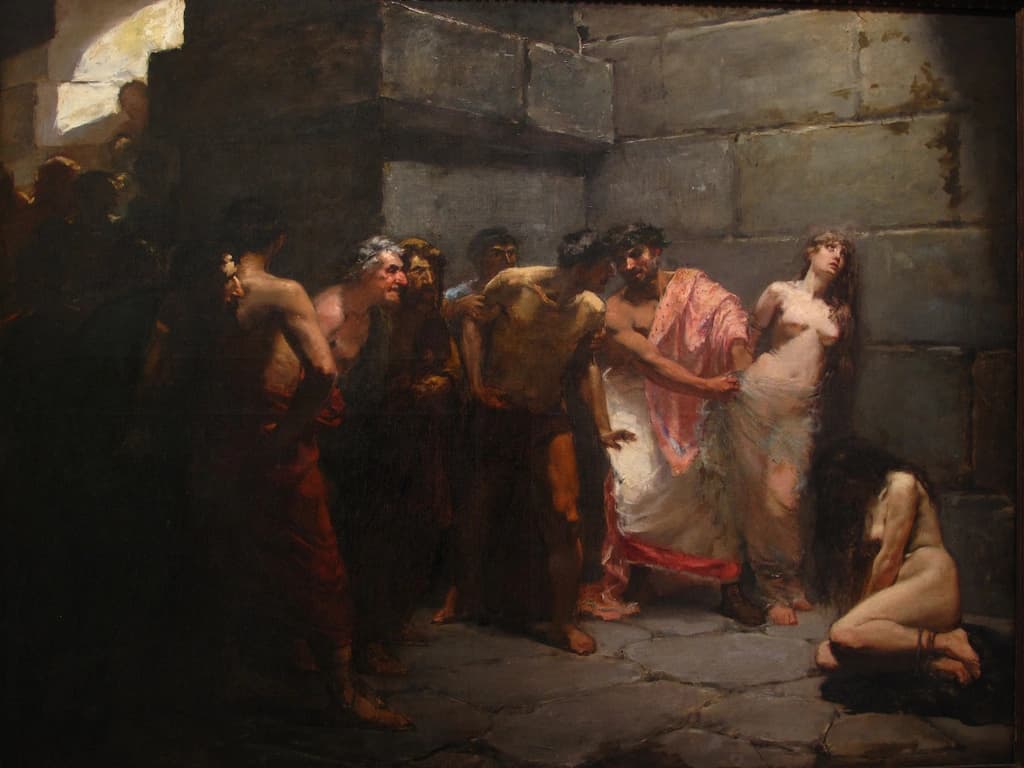
As seen in 'Las Virgenes Cristianas Expuestas al Populacho', he painted classical themes in a grand romantic manner, often contrasted with Juan Luna's vigorous style.1

He established international fame by winning a gold medal in Madrid (1887) and a silver medal at the Paris Exposition Universelle (1889) for 'La barca de Aqueronte'.1
Spending much of his life in Paris, he exhibited works like 'Oedipus y Antigone' at the Salon at Champs-Élysées in 1895, securing his status in the European art world.1
At the 1904 St. Louis Universal Exposition, he received a gold medal for overall participation, with 'El violinista' individually winning a gold medal.1
In his later years, as seen in his 1909 Normandy cliff paintings, his style expanded from genre and history painting to landscapes showing Impressionist influences.1
After a brief 1912 visit to Manila, he died in Barcelona in 1913 while returning to Paris. His remains were brought back to the Philippines for burial in Manila.1
In 2019, his painting 'La Pintura' sold for a record 78.256 million PHP, cementing his status as one of the most valuable and significant artists in Philippine history.1