Artist
Alphonse Mucha
1860–1939
Works (1)
Timeline
Born in 1860 in Moravia (now Czech Republic) to a modest family, Mucha showed early talent in music and drawing, developing a sensibility where art and religion were closely intertwined during his time as a chorister.1
In 1878, he was rejected by the Prague Academy of Fine Arts with the advice to 'find a different career.' This setback led him to Vienna and Paris, eventually resulting in his international success.1
At 19, he became an apprentice scenery painter in Vienna, where he was strongly influenced by Hans Makart's grand historical style, which later shaped his ambition for large-scale historical painting.1
With the support of Count Eduard Khuen Belasi, Mucha received formal art education in Munich and Paris. The Count funded his tuition and living expenses, playing a crucial role in launching his career.1
He studied at Académie Julian and Académie Colarossi in Paris under masters of nudes and historical painting, solidifying his academic foundation while exploring his own decorative style.1
After his patron's support ended in 1889, he began working as a magazine illustrator to earn a living, illustrating works by Guy de Maupassant and honing his skills during a period of financial struggle.1
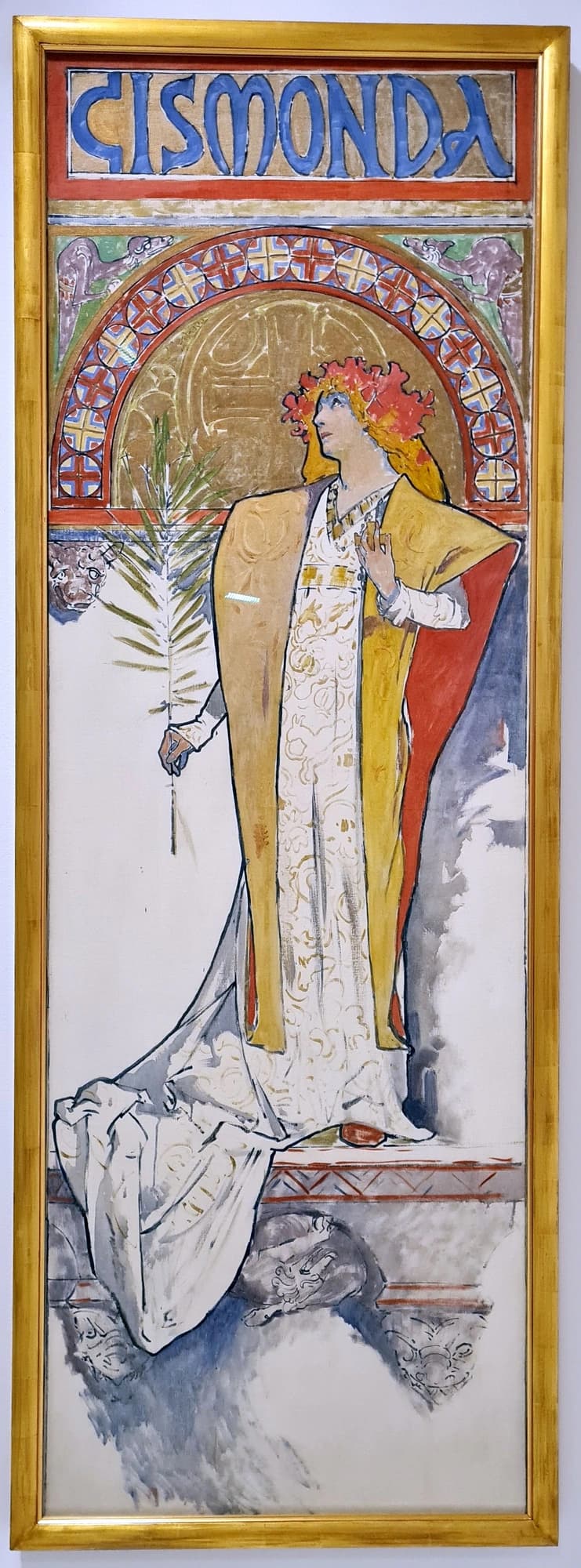
In Paris, he became a sensation with his theatrical posters for Sarah Bernhardt. The 'Mucha Style,' combining female figures with floral motifs, became an iconic design of the Art Nouveau period.1

Returning home at 57, he devoted the second half of his career to 'The Slav Epic,' a series of 20 monumental canvases depicting Slavic history, painted between 1912 and 1926.1
In 1928, he presented 'The Slav Epic' to the Czech nation for the 10th anniversary of independence, considering it his most important work, far surpassing his famous commercial posters in significance.1