Artist
Luke Fildes
Works (1)

Timeline
At 17, Fildes entered Warrington School of Art, later meeting Hubert von Herkomer at South Kensington. They were deeply influenced by the leaders of the British social realist movement.1
Influenced by his activist grandmother, Fildes believed in the power of visual images to change public opinion on poverty and injustice, creating social realist illustrations for The Graphic.1
His illustration of the homeless caught Charles Dickens' attention, leading to a commission for Dickens' final novel, The Mystery of Edwin Drood, a major turning point in his career.1
His illustration of Dickens' empty chair, drawn the day after the author's death, was reprinted worldwide and famously inspired Vincent van Gogh's painting 'The Yellow Chair.'1
Around 1870, he shifted from illustration to oil painting. He established himself as a leading British painter with works like 'The Casual Ward,' which sharply captured social realities.1
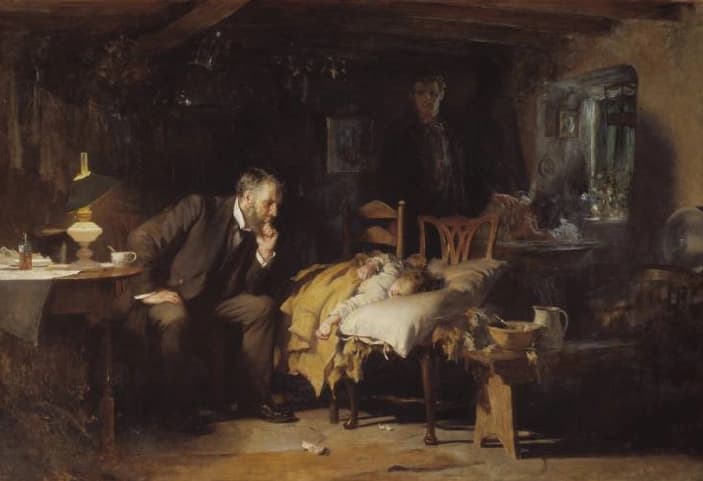
The death of his eldest son Philip from typhoid in 1877 left a lasting memory of the doctor's devotion, which inspired his masterpiece 'The Doctor' fourteen years later.1
Highly regarded as a portraitist, he was commissioned for the coronation portraits of King Edward VII and Queen Alexandra, and was knighted by the King in 1906.1
His masterpiece 'The Doctor' was used by the American Medical Association in 1949 for a campaign against nationalized healthcare, a famous instance of art being used in political debate.1