Artist
Grant Wood
United States, 1891–1942

Timeline
Wood's early training as a metalshop apprentice and silversmith influenced his later artistic precision, seen in his stained glass designs and the meticulous detail of his paintings.1
Near the end of WWI, Wood served in the army designing camouflage. This experience contributed to his skills in visual observation and calculated compositional arrangement.1
From 1924 to 1935, Wood lived and worked in a converted carriage house hayloft in Cedar Rapids, which he creatively addressed as '5 Turner Alley.'1
During a 1928 trip to Munich, Wood was deeply influenced by 15th-century Flemish artists like Jan van Eyck, leading him to adopt the clarity and detailed technique that defined his mature style.1
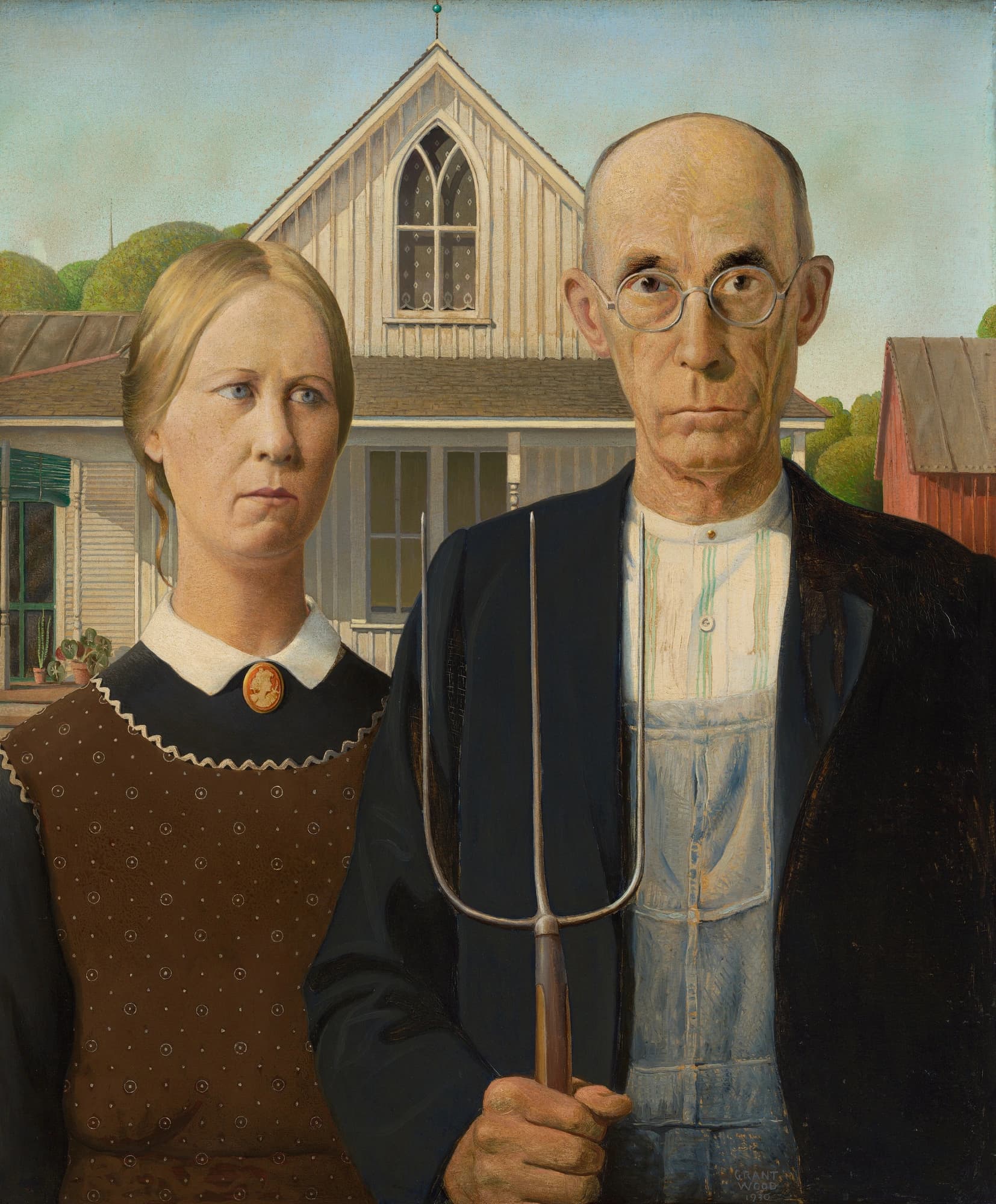
Inspired by a Gothic Revival house with a medieval pointed window in Eldon, Iowa, Wood painted the house along with the kind of people he imagined should live there, creating an American icon.1
The models for American Gothic were Wood's sister, Nan, and his dentist. Nan insisted she be depicted as the farmer's daughter rather than his wife to avoid appearing older than she was.1
Wood became a leader of Regionalism, rejecting European abstraction in favor of figurative depictions of the rural Midwest, and encouraged artists like Thomas Hart Benton to return to the region.1
Initially viewed as a satire of rural narrow-mindedness, American Gothic came to be seen during the Great Depression as a symbol of the steadfast American pioneer spirit.1
In 1932, during the Great Depression, Wood co-founded the Stone City Art Colony to support struggling artists and lectured nationwide on the importance of Regionalism.1
While teaching at the University of Iowa, Wood mentored Elizabeth Catlett, encouraging students to draw inspiration from their own familiar environments and experiences.1