Artist
Johann Heinrich Wilhelm Tischbein
Works (1)
Timeline
Born in 1751 into the famous Tischbein family of artists, he apprenticed at age 14 with his uncle, 'the Kassel Tischbein,' establishing his foundation as a portrait painter.1
During his 1779 stay in Rome, his style shifted significantly from decorative Rococo to strict, idealistic Classicism, marking the most important turning point in his artistic career.1
With a scholarship recommended by Goethe, he returned to Italy in 1783. He lived with Goethe in Rome and taught him to draw, fostering a deep friendship between the two.1
Their shared apartment on Rome's Via del Corso is now the 'Casa di Goethe' museum, serving as a valuable site that preserves the interactions and daily lives of artists of that era.1
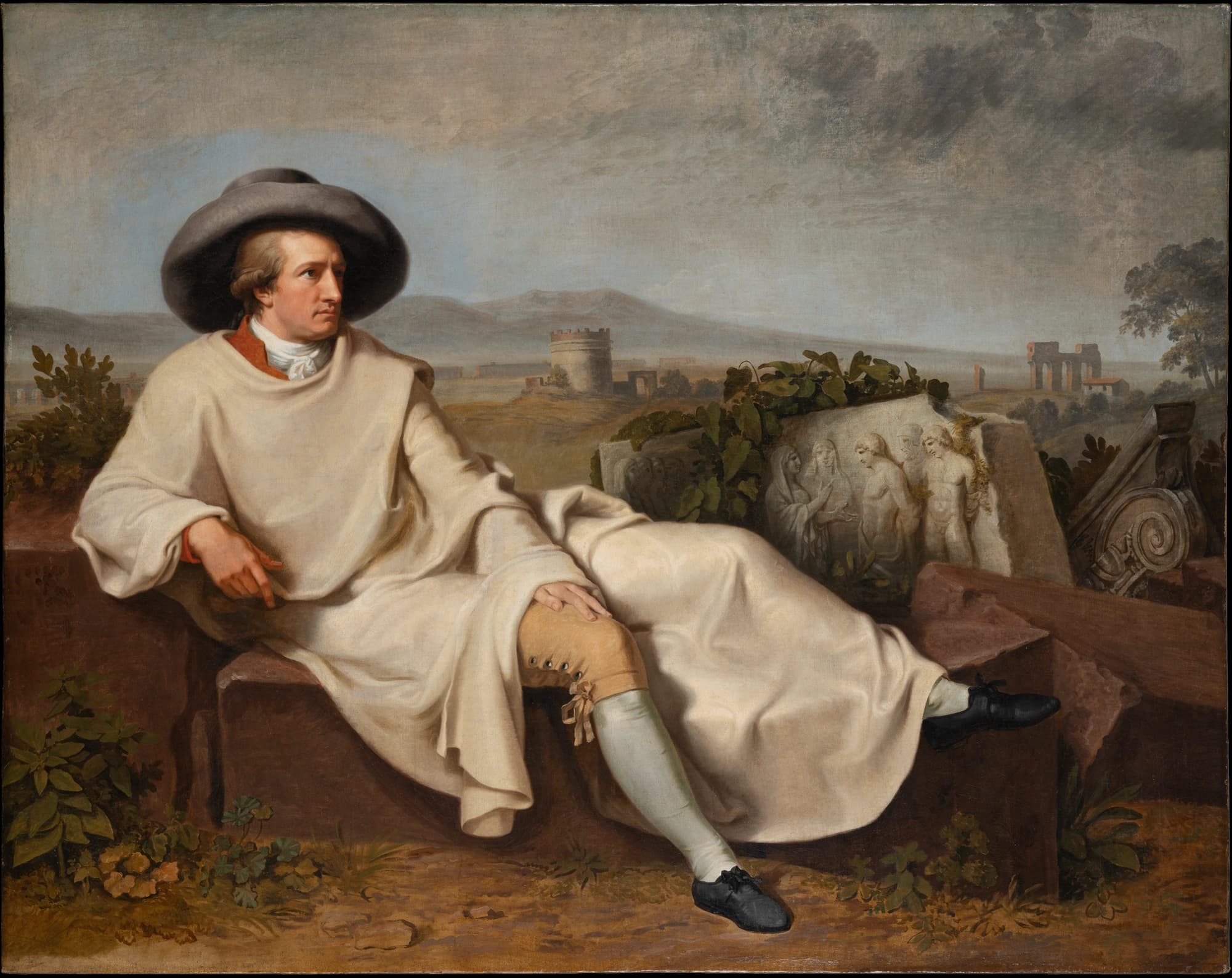
His 1787 masterpiece 'Goethe in the Roman Campagna' depicts the author against ancient ruins and remains a world-renowned masterpiece of German Neoclassical portraiture.1

For ten years starting in 1789, he served as the director of the Accademia di Belle Arti di Napoli, exerting great influence as both an educator and a researcher of ancient art.1
While in Naples, he produced exquisite etchings and engravings based on Sir William Hamilton's collection of ancient Greek vases, contributing to the spread of Neoclassicism.1
In 1799, caught in the political upheaval of the French invasion of Naples, he was forced to resign his directorship and leave Italy to return to Germany.1
Beyond portraits, he illustrated Homer's Iliad and Odyssey. His attempts to visualize classical literature were highly regarded by the educated middle class of the time.1
In his later years at Eutin Castle serving the Grand Duke of Oldenburg, he wrote his autobiography 'Aus meinem Leben,' a vital historical source on the art world and Goethe.1