The post stations of the Tokaido, the streets of Edo — to people of the time, these were everyday sights everyone knew by heart. And yet, in front of a single sheet by Hiroshige, we find ourselves stopping. Perhaps you have felt this too.
If we had to name the reason in a word, it may lie in an extraordinary attention to "where to look from." Utagawa Hiroshige (1797–1858) took the world by storm with his views of famous places and remained at the forefront throughout his life. In fact, he began by drawing actor prints and beauties; it was the death of his teacher Toyohiro in 1828 that led him to place landscape at the center of his work. What he pursued after that turn was, it seems, the invention of viewpoint and composition. Let us follow three landscape series along a single thread.[1]
Catching a traveler’s moment through weather and hour
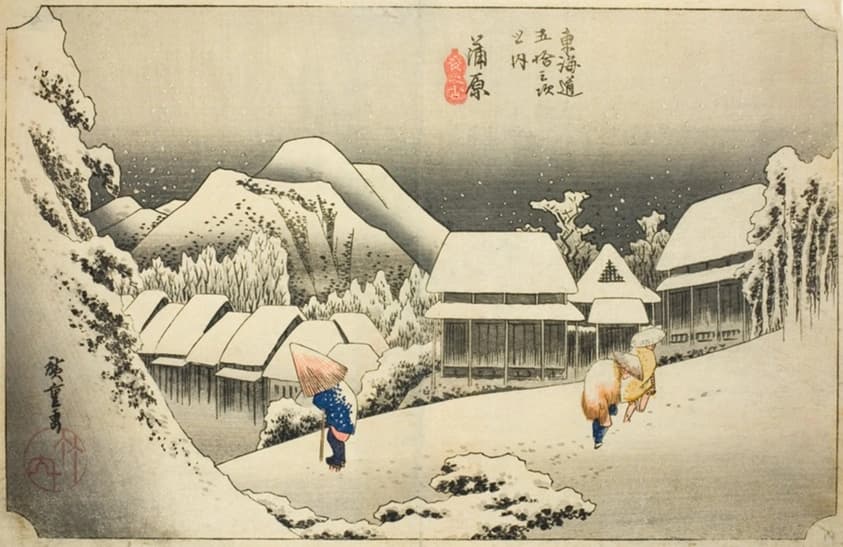
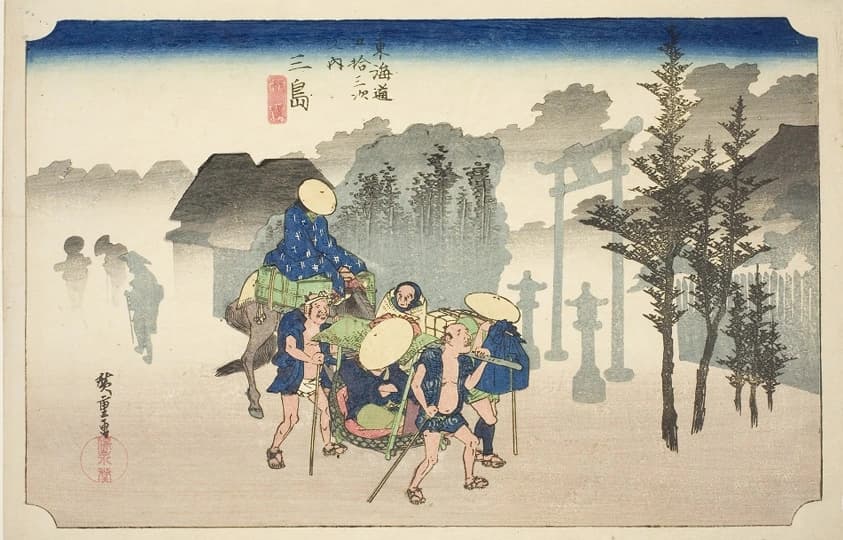
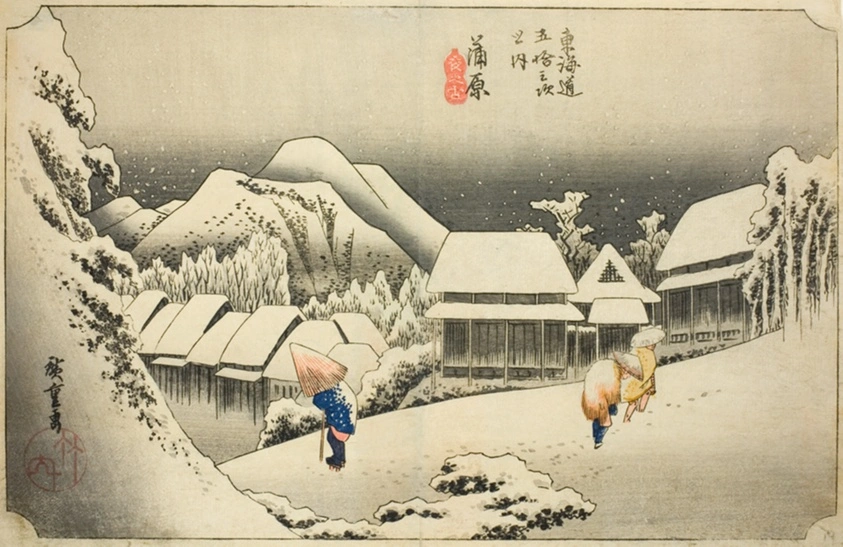
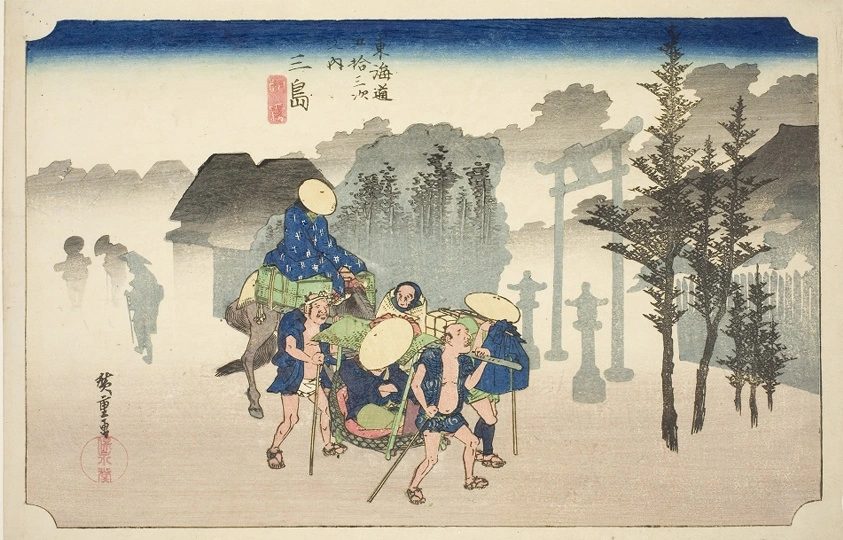
The first that comes to mind is the series on the stations of the Tokaido. Hiroshige is said to have traveled through Kai Province and other regions, sketching from life and drawing on those sketches in his work. Rather than merely recording a place, he seems to have wanted to paint the time and air that flowed through it.[1]
The hush of night snow settling; a station wrapped in morning mist. The same road shows a different face as the weather and the hour change. Hiroshige chose that single "moment" and fixed it on the page as a traveler’s scene.
Hiroshige Blue, a new kind of blue
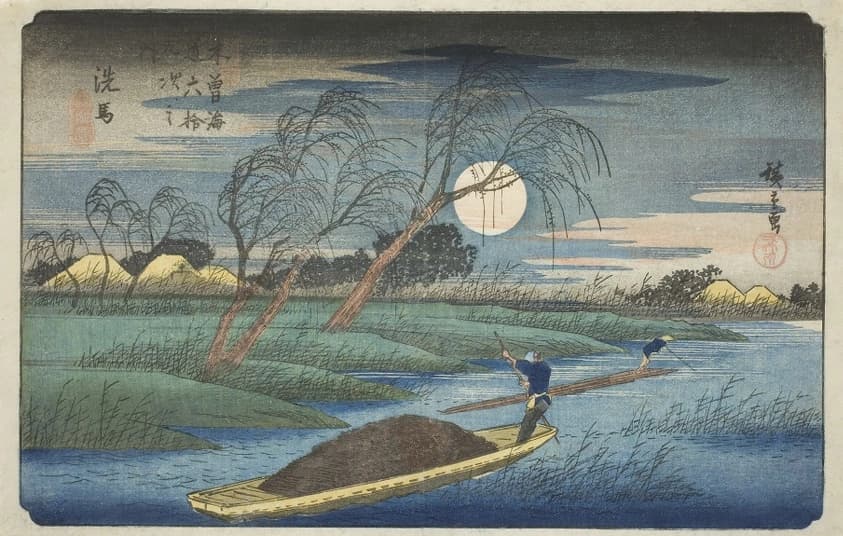
When we speak of Hiroshige’s pictures, that vivid blue is indispensable. The blue in his works was praised in the West as "Hiroshige Blue." It came from a new pigment newly imported from Europe — "Bero-ai" — and because woodblock printing yields brighter color than oil, it was likened to Vermeer Blue and given that name.[1]
A new blue, it seems, changed Hiroshige’s skies and waters. The streaks of a sudden shower, the stillness of night, the breadth of a river’s surface — there are expressions that only this color could bring. And this blue would, in time, cross the sea.
The twilight light falling on a mountain road
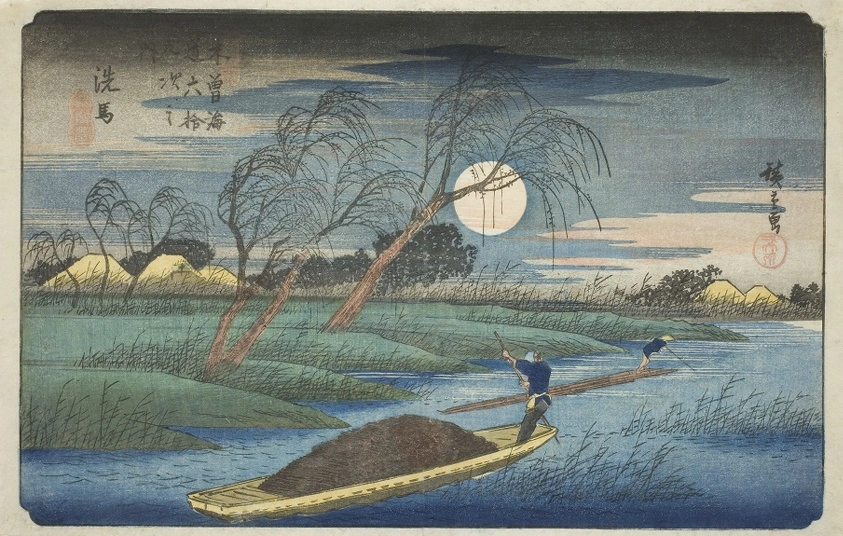
If the Tokaido was a journey along the coast, the Kiso road runs through mountain country. Known as a collaboration with Keisai Eisen, this series depicts stations tucked among the hills. One sheet in particular — where the light of twilight quietly shifts — tells us much about Hiroshige’s eye for the hour. Neither day nor night, but the in-between time. In the attempt to render that subtle light in woodblock, his way of painting a scene by its "hour" runs through.
Past a wheel, a bridge on the diagonal — viewpoint at its peak
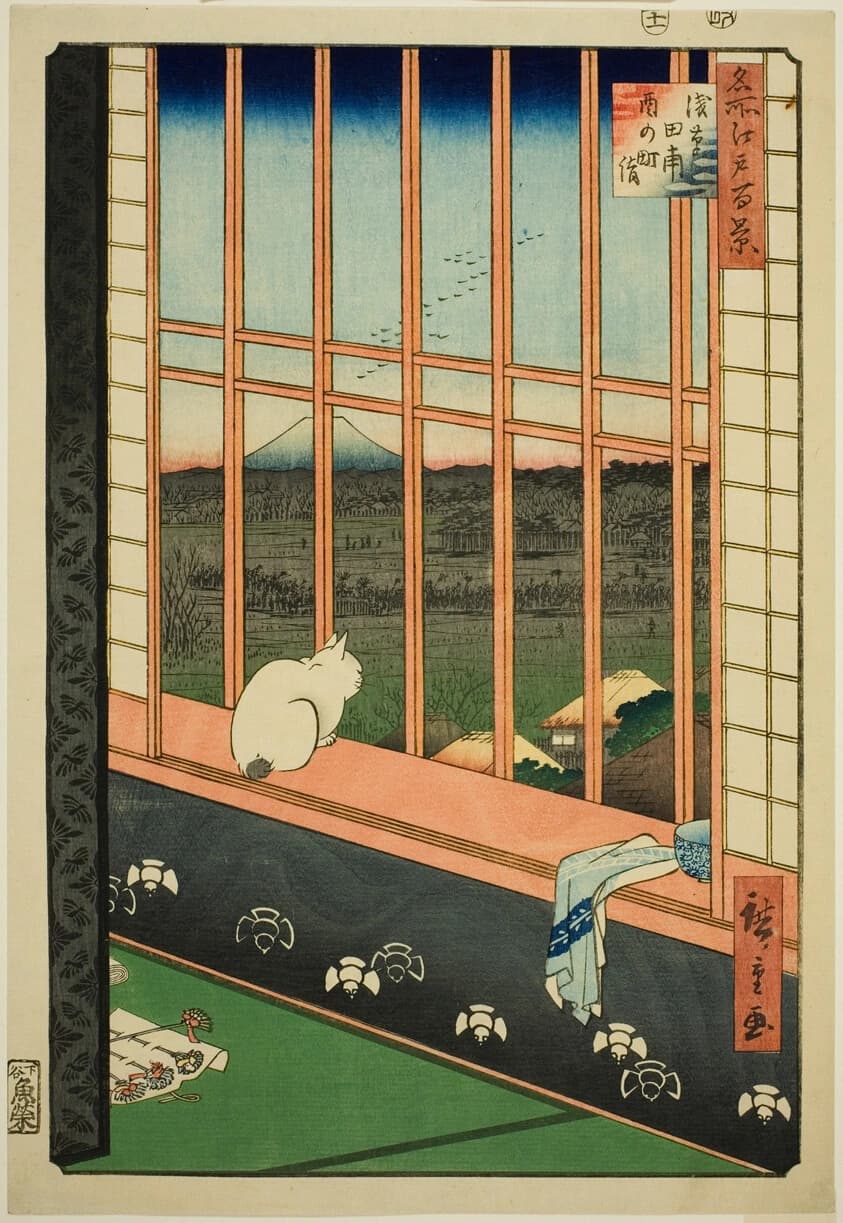
Then, in his final years — across the three years from turning sixty to his death at sixty-two — Hiroshige took on a series that would be his last. Made between 1856 and 1858, it is One Hundred Famous Views of Edo. There are 118 sheets bearing Hiroshige’s signature, said to be among the largest number for a single ukiyo-e series by one artist.[2]
What Hiroshige arrived at in this series was the "near-view composition," placing an extremely large motif in the foreground. Boldly cropping near and far, using bird’s-eye views and zoom — cutting a bridge on the diagonal, enlarging a foreground motif to fill the frame. The invention of "where to look" seems to reach its peak here. It was also in this period that he opened up nature-rich areas like Oji and Meguro as new famous places, widening his field from the city to the suburbs.[2]
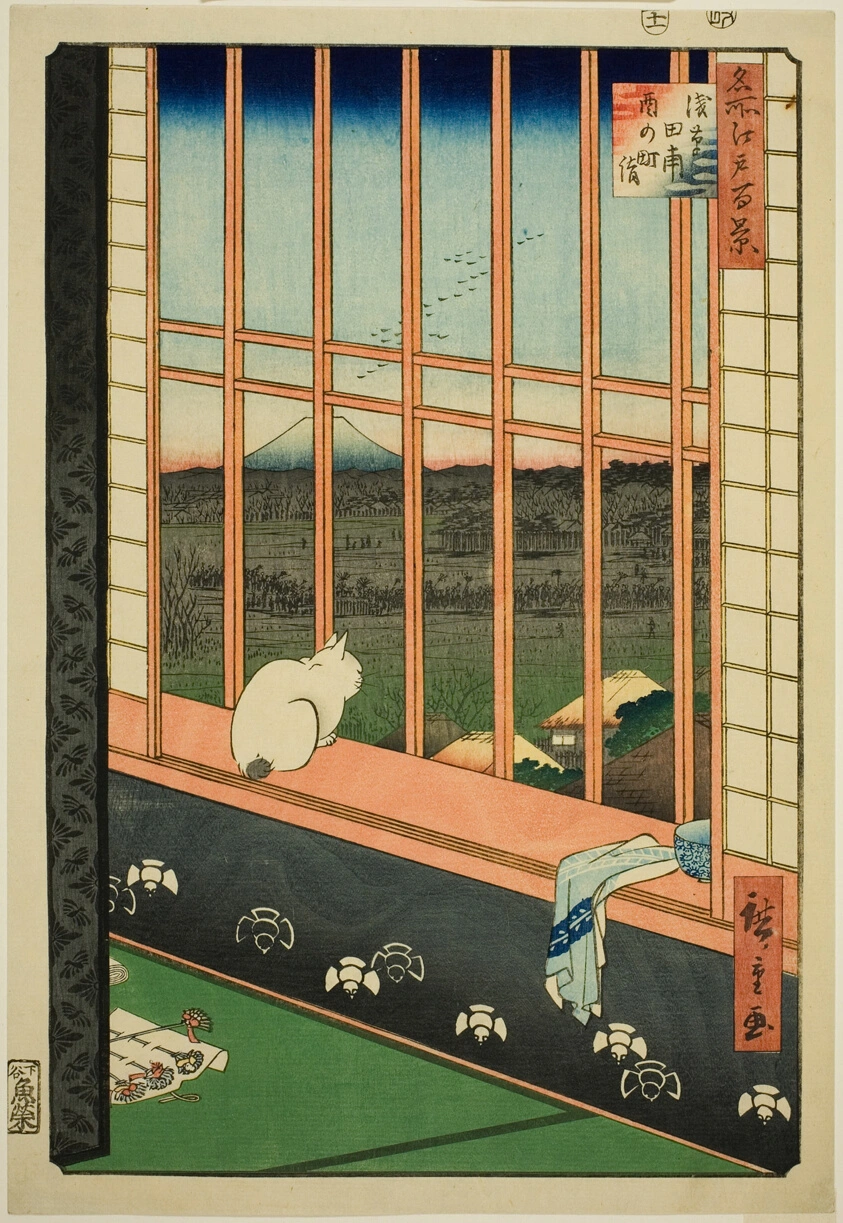
After Hiroshige’s death, the series received additions by Hiroshige II and was published as "Ichiryusai Hiroshige, Once in a Lifetime: One Hundred Views of Edo." Its 120 sheets include works signed by Hiroshige II and a table of contents.[2]
Hiroshige’s blue and composition cross the sea
Hiroshige’s color and composition influenced late-19th-century French Impressionist and Art Nouveau artists and are said to have helped spark the worldwide vogue of Japonisme. It is a well-known episode that Van Gogh copied a Hiroshige Fuji into the background of his oil painting "Père Tanguy."[3]
The same view — yet a single Hiroshige stops us in our tracks. The reason may lie in the invention of viewpoint and composition he spent his life refining. Change only where you look from, and a familiar scene becomes an entirely new picture. The arc of that invention runs through his three great series.