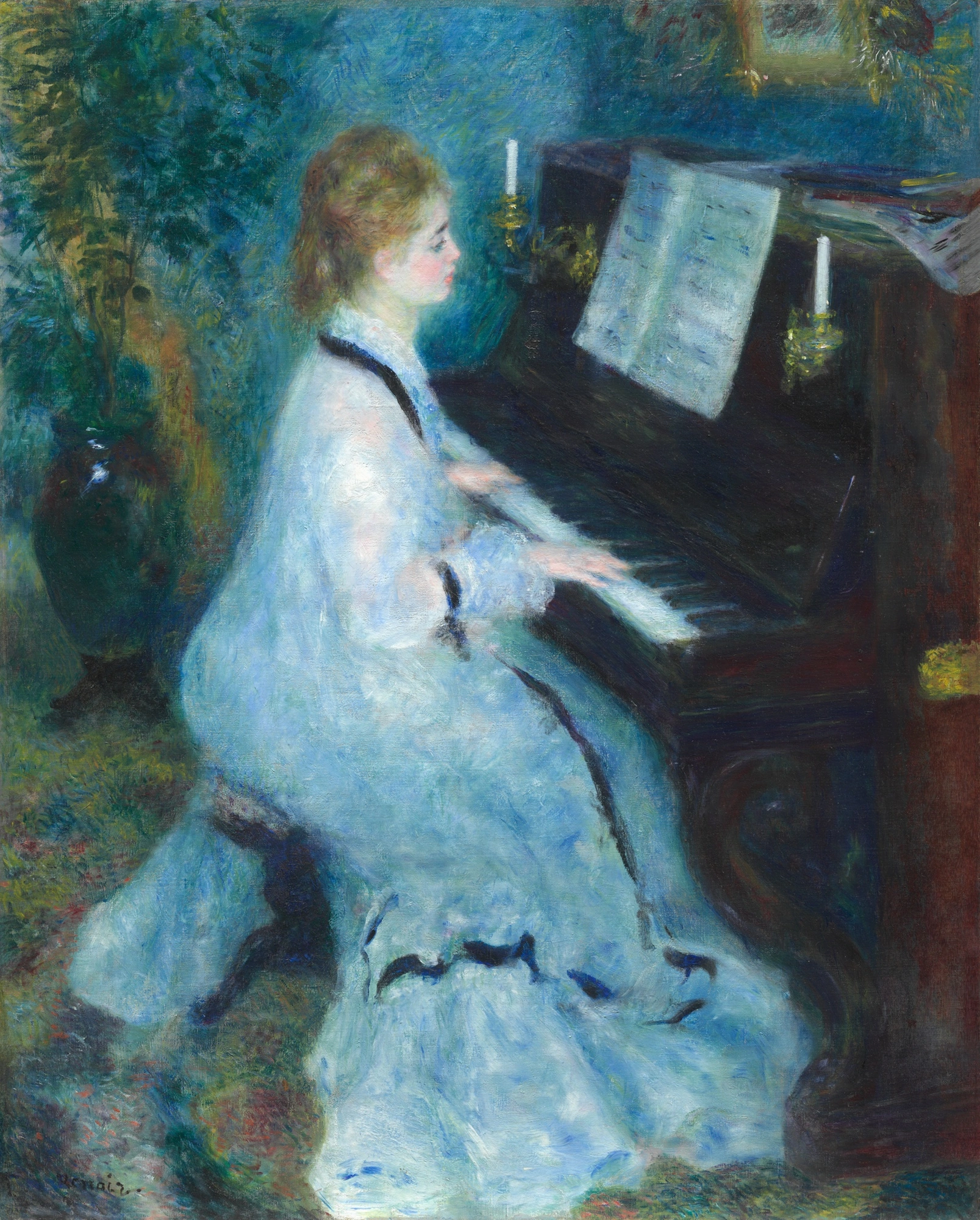
Woman at the Piano
穏やかに
2分08秒
In the late nineteenth century, Pierre-Auguste Renoir stood as a leading light of the Impressionist movement, a painter dedicated to capturing the sheer radiance of light. This masterpiece, painted between 1875 and 1876, dates from a pivotal era when his involvement with the Impressionist circle was at its peak. Within this canvas, measuring ninety-three centimeters high, Renoir offers us an intimate glimpse into the tranquil domestic life of a nineteenth-century French household.
Let us look toward the center of the composition, at the young woman seated at the piano. Her gown, a delicate fusion of pale blue and white, seems to breathe in the soft light filtering through a nearby window. Her profile, cast in quiet contemplation of the keys, speaks of a moment of pure devotion to her music. Atop the dark, substantial piano, the luminous white of the sheet music catches the eye, suggesting a faint melody that lingers within the room’s stillness.
In nineteenth-century France, a woman at the piano was a powerful symbol of culture and refinement. Renoir famously remarked that "a picture should be something pleasant," and he pursued this ideal of beauty throughout his life. By treating shadows not as dark voids, but as a play of reflected colors, he brought a remarkable sense of transparency and harmony to an interior scene that might otherwise have felt heavy or somber.
Here, in a quiet corner of the Art Institute of Chicago, this melody continues to resonate. We invite you to pause, step away from the rush of daily life, and lose yourself in the "quiet joy" that Renoir captured so tenderly.