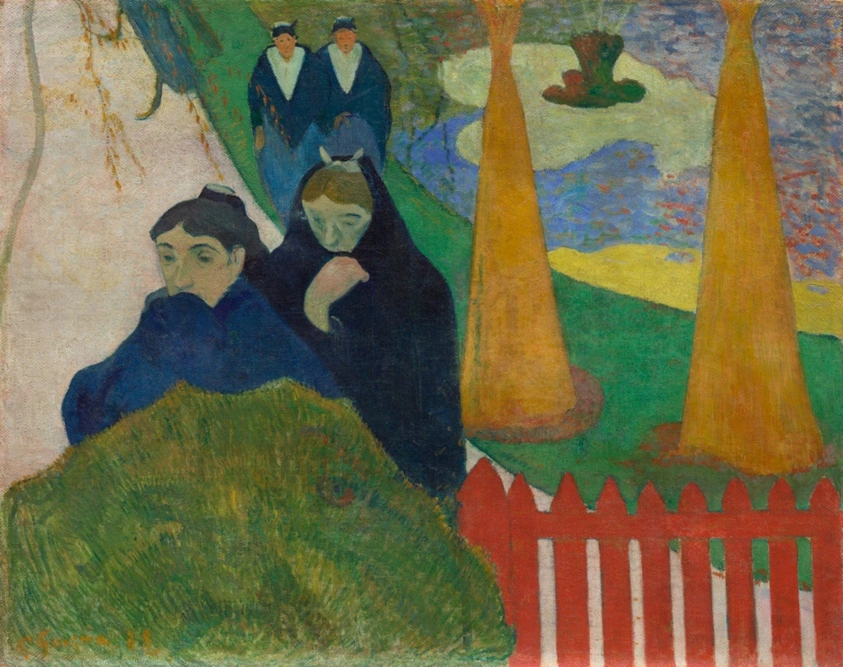
Arlésiennes (Mistral)
穏やかに
2分31秒
Arles, 1888. This work was painted during a period of intense creative upheaval, while Paul Gauguin lived alongside Vincent van Gogh in the legendary "Yellow House." It depicts the public garden situated just across from their home. Despite the "Mistral"—the biting cold wind that swept through the region—a profound silence reigns over the canvas.
Four women pace slowly through the grounds. Curiously, the two in the foreground cover their mouths, their gazes turned away from us. The colors are applied in flat, bold washes, while orange shrubs, wrapped against the winter frost, create a distinct, geometric rhythm. To the upper left, the paths and benches rise at an impossibly steep angle, defying logical perspective to create a space that feels detached from reality.
Unlike Van Gogh’s spontaneous brushwork, Gauguin constructed a symbolic world based on meticulous planning. Look closely at the bush on the left... Gauguin has intentionally embedded shapes suggesting eyes and a nose, giving the foliage a watchful, almost haunting presence. The gestures of the women, evoking silence and secrets, reflect Gauguin’s desire to explore the deep mysteries and human emotions that lie beneath the surface of appearances.
There is a stillness here, an atmosphere that is almost meditative. Within this harmonious composition, we might just find the spiritual peace that the artist so fervently sought.